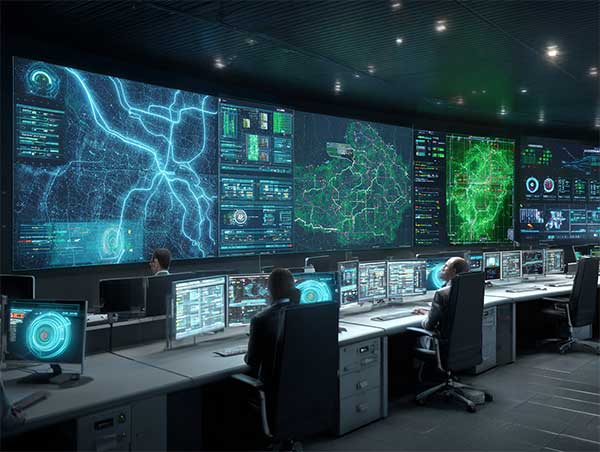
All visuals are AI-generated for illustrative purposes.
Executive Summary
In 2025, EverSphere’s ShadowIntel completed live operational trials with NATO-aligned defence partners. By fusing satellite imagery, signals intelligence, and live tactical feeds into a single predictive control layer, ShadowIntel achieved sub-300ms threat detection, continuous strategy recalibration, and resilient performance in degraded network conditions.
Unlike traditional command systems, ShadowIntel operates as a copilot: surfacing recommendations in real time while leaving final judgement to human commanders. Every action is logged and auditable under EverSphere’s Ethics & Assurance Framework.
Industries Impacted
- Defence & Security
- Disaster Response
- Critical Infrastructure Resilience
Geographies: NATO-aligned exercises; expansion planned for Asia-Pacific and humanitarian deployments.
Approach
ShadowIntel replaces siloed tools with a unified intelligence copilot, designed for speed, resilience, and auditability.
Data foundation (live, governed, secure)
- ISR inputs: satellite imagery, SAR/radar, multispectral drone feeds.
- Signals intelligence: comms intercepts, spectrum monitoring, adversarial spoof detection.
- Tactical feeds: blue-force tracking, unit comms, logistics telemetry.
- Environmental overlays: terrain, weather, infrastructure status.
Core Models
- Threat detection: deep vision + multimodal fusion, <300ms mean response.
- Adversary manoeuvre prediction: GNN + stochastic game theory simulation.
- Adaptive strategy modelling: continuous recalibration as new feeds arrive.
- Uncertainty quantification: confidence bands on every recommendation.
- Explainability: human-readable reason codes (“Signals surge from West flank; predicted manoeuvre probability 0.72”).
System Design
- Human-in-the-loop: commanders confirm all actions; no automated execution.
- Model Zoo integration:
- Kai → optimisation under adversarial uncertainty.
- Milo → communication layer for contextual, human-friendly alerts.
- Resilient comms: low-bandwidth fallback, mesh routing, anti-spoof protocols
- Auditability: immutable logs; red-team stress-tested by Dr Abigail Shaw’s Assurance group.
Deployment
- Roll‑out:
field-ready edge compute nodes hardened for battlefield conditions. - Integration time:
10–14 weeks, including war-gaming simulations and sandbox exercises - Governance:
Assurance Framework enforced — red-teaming, humanitarian law compliance, adversarial audits.
Primary Outcomes
Secondary Outcomes
“In contested environments, time is the most valuable commodity. ShadowIntel accelerates clarity.”
Methodology
- Joint NATO-aligned field trials.
- Live data feeds: satellite, SIGINT, tactical comms.
- Parallel evaluation against incumbent C2 systems.
- Independent audits of assurance, compliance, and explainability.
Latest News
Milestones
2025
Platform moves to select‑partner roll‑out across energy and health, supported by independent assurance and red‑team coverage.
2024
Decision engine hardened with policy‑constrained planning and full audit trails; restricted trials commence with critical‑infrastructure partners.
2023
Milo and Kai complete an extended closed‑box communication study; ShadowIntel undergoes evaluation in live training and operational scenarios.
Intelligence Lag
Hours to collate satellite, signals, and tactical data before commanders see a full picture
Data Silos
Separate platforms for imagery, comms, and field reports → fragmented situational awareness
Uncertain Environments
Degraded comms, contested networks, adversarial spoofing, rapid manoeuvre cycles
The Problem
Modern battlefields and crisis zones generate overwhelming volumes of intelligence: satellite passes, drone feeds, signals intercepts, and frontline reports. Yet the systems processing them remain slow, siloed, and prone to failure under pressure.
Analysts often take hours to integrate disparate sources, while adversaries manoeuvre in minutes. In contested or degraded environments, commanders face blind spots, conflicting signals, and decision latency that can cost lives.
Traditional command systems are reactive, brittle under network disruption, and unable to provide the adaptive foresight demanded by modern operations. What’s missing is a copilot that accelerates clarity without bypassing human authority.